
Cross Necklace Meaning Men UK 2026: Faith + Style
The cross became a Christian symbol roughly 250 years after Christianity itself began.

For the first two and a half centuries of the religion, early Christians used the fish, the anchor, and the chi-rho monogram. The cross was deliberately avoided because Roman crucifixion was still in active use as a method of execution and the symbol was associated with shame, not faith. Only after Emperor Constantine outlawed crucifixion in 337 AD did the cross become acceptable as a religious symbol, and only after that did the wearing of crosses as personal devotion begin.
That history is the part most modern cross necklace articles skip past, and it matters because the cross has carried symbolic weight, sometimes shameful, sometimes triumphant, sometimes purely aesthetic, throughout its entire history. A cross worn on a chain is never neutral. It signals something to anyone who notices it, and what it signals changes depending on who’s wearing it, where, and how. Worn by a practising Catholic, it’s an act of faith. Worn by a hip-hop artist, it’s a tribute to a lineage that runs through Tupac, Biggie, and Run-DMC. Worn by a man with no religious context, it’s a design choice that some viewers will read as faith anyway.
This is the guide for understanding the meaning of a cross necklace for men in 2026, when to wear one, and how to choose.
Background: I founded Monrich, a UK men’s jewellery brand. I see this category from inside, which is part of how I read other brands.
The religious meaning of the cross

The cross is the central symbol of Christianity. It represents the crucifixion of Jesus Christ and, in Christian theology, the path to salvation through faith.
Variations by denomination
Latin cross (vertical bar longer than horizontal): the most common Christian cross. Worn by Catholics, Anglicans, Lutherans, Methodists, Baptists, and many other denominations.
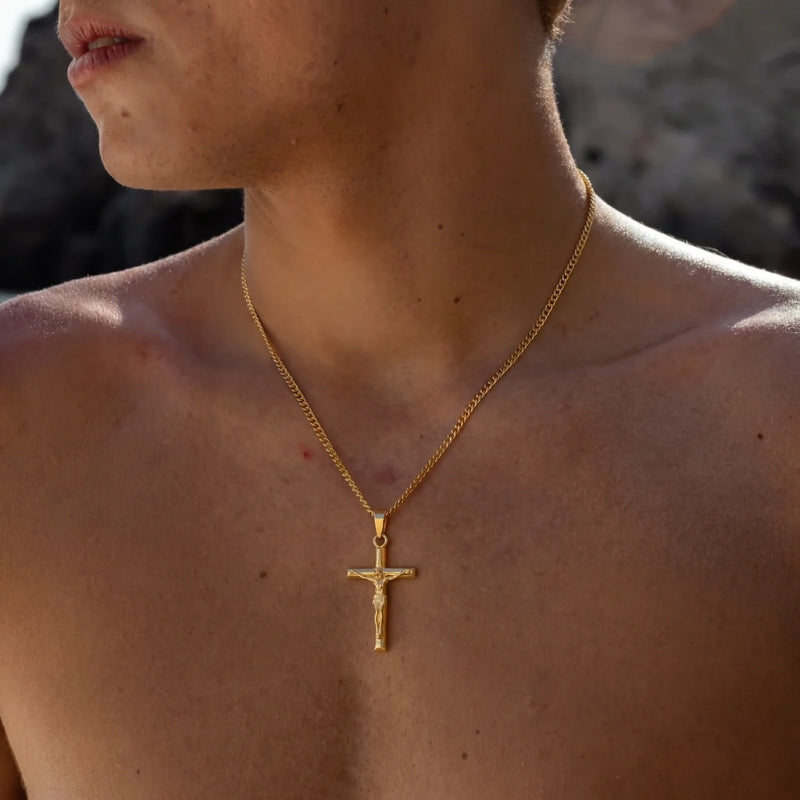
Crucifix (Latin cross with the figure of Christ): specifically Catholic. The figure of Christ on the cross represents the actual moment of crucifixion.
Orthodox cross (three horizontal bars): Eastern Orthodox tradition. The top bar represents the inscription, the middle is the main beam, the angled bottom bar represents the footrest where Christ’s feet were nailed.
Greek cross (equal-length arms): used in early Christian iconography and some Orthodox traditions.
Coptic cross: Egyptian Coptic Christian tradition. Often with decorative elements at the ends.
For Christian wearers, the design typically reflects denomination.
Cross necklace as cultural symbol
Beyond the strict religious meaning, the cross necklace carries additional cultural weight:
Identity / heritage marker
For many wearers, the cross signals family / cultural background more than active faith. Common among: - Italian Catholics (inherited from grandparents) - Greek and Eastern European Orthodox families - Latin American Catholic families - African and Afro-Caribbean Christian traditions
Memorial / tribute
A cross necklace worn in memory of a deceased family member or loved one. Often the cross belonged to the deceased.
Spiritual identity (broader than religious)
Some wearers don’t actively practice Christianity but identify with broader spiritual symbolism. The cross becomes a connection to something larger than the self.
Cultural code (hip-hop, streetwear)
In hip-hop and streetwear culture since the 1990s, the cross necklace has been a recurring style signature. Often iced-out (pavé CZ stones) or in chunky designs. The religious meaning is sometimes background context, sometimes foregrounded.
Counter-culture
In some subcultures (goth, alternative, metal), inverted crosses (St Peter’s cross) or non-traditional cross designs carry anti-establishment or counter-religious meaning. Be aware of context if choosing these.
In modern men’s fashion, a cross necklace is acceptable across most demographics regardless of religious belief.
Cross necklace as fashion (2026)

In modern men’s fashion, a cross necklace is acceptable across most demographics regardless of religious belief. The aesthetic codes are well-established:
- Streetwear / hip-hop: medium to large cross, often pavé CZ, on Cuban chain
- Minimal modern: small to medium cross, plain polish, on thin curb or cable chain
- Heritage / classic: medium cross, sterling silver or solid gold, on curb or rope chain
- Vintage / antique: old cross piece worn for character
For UK men in 2026, wearing a cross without religious affiliation is generally accepted but worth being aware of context: - In specifically religious settings (visiting a mosque, synagogue, Hindu temple), wearing a Christian cross can be perceived as out of place - In family settings with religious members, a cross worn purely as fashion might be questioned - In professional settings, the cross is usually low-key enough not to be an issue
Different cross designs and their meanings
Latin cross (most universal)
Vertical bar longer than horizontal. Simple. Works for any wearer (religious or fashion). The default.
Crucifix
Cross with Christ figure. Specifically Catholic. More detailed, more religious read.
Orthodox cross
Three horizontal bars (two regular, one angled at bottom). Eastern Orthodox identification.
Cross of St Peter (inverted Latin cross)
Latin cross flipped upside down. Originally a symbol of humility (St Peter requested to be crucified upside down, considering himself unworthy of dying like Christ). Has been appropriated by anti-Christian and counter-culture groups. Be aware if wearing.
Celtic cross
Latin cross with a circle around the intersection. Celtic / Irish heritage. Often used in Irish, Welsh, Scottish family pieces.
Coptic cross
Egyptian Coptic Christian tradition. Decorative ends.
Maltese cross
Eight-pointed cross. Historical / military / fraternal symbol. Not strictly Christian, used by Knights of Malta, fire services, some military orders.
Iced-out cross
Modern hip-hop variation. Latin or Greek cross covered in pavé CZ stones. Aesthetic-led, often without specific religious intent.
Designer / abstract cross
Modern interpretations by jewellery designers. Stylized, sculptural. Worn for design rather than religious intent.
Modern interpretations by jewellery designers.
When to wear a cross / when not to

Appropriate
- Daily wear as personal style or faith identification
- Religious services and ceremonies
- Family gatherings (especially in religious families)
- Memorial services
- Personal milestones (baptism, confirmation, christening)
Consider carefully
- Religious settings of different faiths (mosque, synagogue, temple), can be perceived as out of place
- Job interviews / formal business in conservative industries, keep under shirt
- Funerals (your own faith vs the deceased’s, usually fine but use judgement)
Generally avoid
- Costume parties / Halloween (wearing religious symbols as costume is widely considered disrespectful)
- Settings where religious tension is high (politically charged contexts)
- Anti-religious or satirical contexts (mixed messages)
Choosing a cross necklace by intent
Religious / faith intent
- Standard Latin cross or denomination-specific (crucifix for Catholic, Orthodox cross for Orthodox)
- Sterling silver or solid gold (traditional religious materials)
- Subtle to standard size (10-25mm vertical)
- Worn under shirt or visible at open collar
- Often blessed or consecrated in religious ceremony
Heritage / family intent
- Often inherited piece
- Design specific to family tradition (Italian, Greek, Latin American, etc.)
- Sterling silver or solid gold typical
- Worn visibly or under shirt
- Strong sentimental meaning
Memorial / tribute intent
- Cross belonging to or commemorating the deceased
- Sometimes engraved with name and dates
- Solid metals for longevity (sterling, solid gold)
- Worn close to heart / under shirt often
- Personal significance dominant
Fashion / aesthetic intent
- Modern designer pieces or contemporary brand pieces
- PVD-plated 316L or sterling silver
- Wide range of sizes
- Worn visibly with appropriate outfit (streetwear, smart casual)
- Religious meaning is background, aesthetic is foreground
Hip-hop / streetwear intent
- Iced-out pavé CZ cross
- Plated stainless or sterling base
- Medium to large size (30-50mm)
- Worn visibly with Cuban chain
- Cultural / stylistic intent primary
For the first two and a half centuries of the religion, early Christians used the fish, the anchor, and the chi-rho monogram.
Materials by use case
For religious / heirloom intent
- Sterling silver (traditional religious material, classic)
- Solid 9K-18K gold (premium, lasting)
- Vintage / antique (often inherited)
For daily fashion wear
- PVD-plated 316L (best value, durable)
- Sterling silver (premium daily wear, patinas with character)
For iced-out hip-hop
- PVD-plated 316L + CZ stones (accessible iced look)
- Sterling + vermeil + CZ (premium iced)
- Solid gold + diamonds (investment iced, £2000+)
For minimal modern
- Sterling silver (clean polished cross)
- PVD-plated 316L (gold-tone polished, no stones)
Best brands UK 2026
For traditional religious / heritage crosses
- Independent UK jewellers: sterling and solid gold crosses with traditional designs. £100-1500.
- Religious jewellery specialists: denomination-specific designs (Catholic, Orthodox, Anglican).
For fashion crosses (daily wear)
- Monrich: PVD-plated 316L crosses, declared spec, BOGO. £40-150. Browse cross collection.
- Craftd London: electroplated crosses, broader catalogue. £45-150.
For iced-out / hip-hop crosses
- Cernucci: strong iced cross range. £50-300.
- King Ice (US): premium iced. £100-1000+ + UK customs.
For premium minimal crosses
- Hatton Labs: sterling silver. £150-400.
- Le Gramme: solid silver / gold. £300-2000.
For the first two and a half centuries of the religion, early Christians used the fish, the anchor, and the chi-rho monogram.
FAQ
Do you have to be Christian to wear a cross necklace?
No. In modern UK fashion, wearing a cross necklace is acceptable regardless of religious affiliation. Be aware of context in specifically religious settings of other faiths.
Is wearing a cross without being religious disrespectful?
Generally no in modern fashion context. Some religious communities and family members may view it as inappropriate. Use judgement based on your specific social context.
What's the difference between a cross and a crucifix?
A cross is the bare shape (vertical + horizontal bars). A crucifix has the figure of Christ on the cross. The crucifix is specifically Catholic / Eastern Orthodox; the cross is shared across all Christian denominations and used in non-religious fashion.
What size cross should a man wear?
For subtle / religious / daily wear: 25-35mm vertical. For statement / hip-hop wear: 40-60mm vertical. The size should match your intent and outfit context.
Is an iced-out cross disrespectful?
Some traditional Christian wearers view iced-out / heavily decorated crosses as inappropriate for religious wear. Modern interpretations embrace iced-out crosses as cultural / aesthetic expression. Personal choice.
What chain length for a cross necklace?
22-24 inches for men is standard. The cross falls mid-chest, visible above most necklines. Adjust by 2 inches up or down for taller or shorter frames.
Built after wearing the others.
Different by design.
PVD-plated 316L. 1-2 micron thickness declared. 12-month tarnish guarantee in writing. Permanent buy one get one free across the full catalogue.
Browse Monrich → UK shipping 2-4 days / 30-day returns / no customs


